

Klaviyo to Webflow
Project Summary
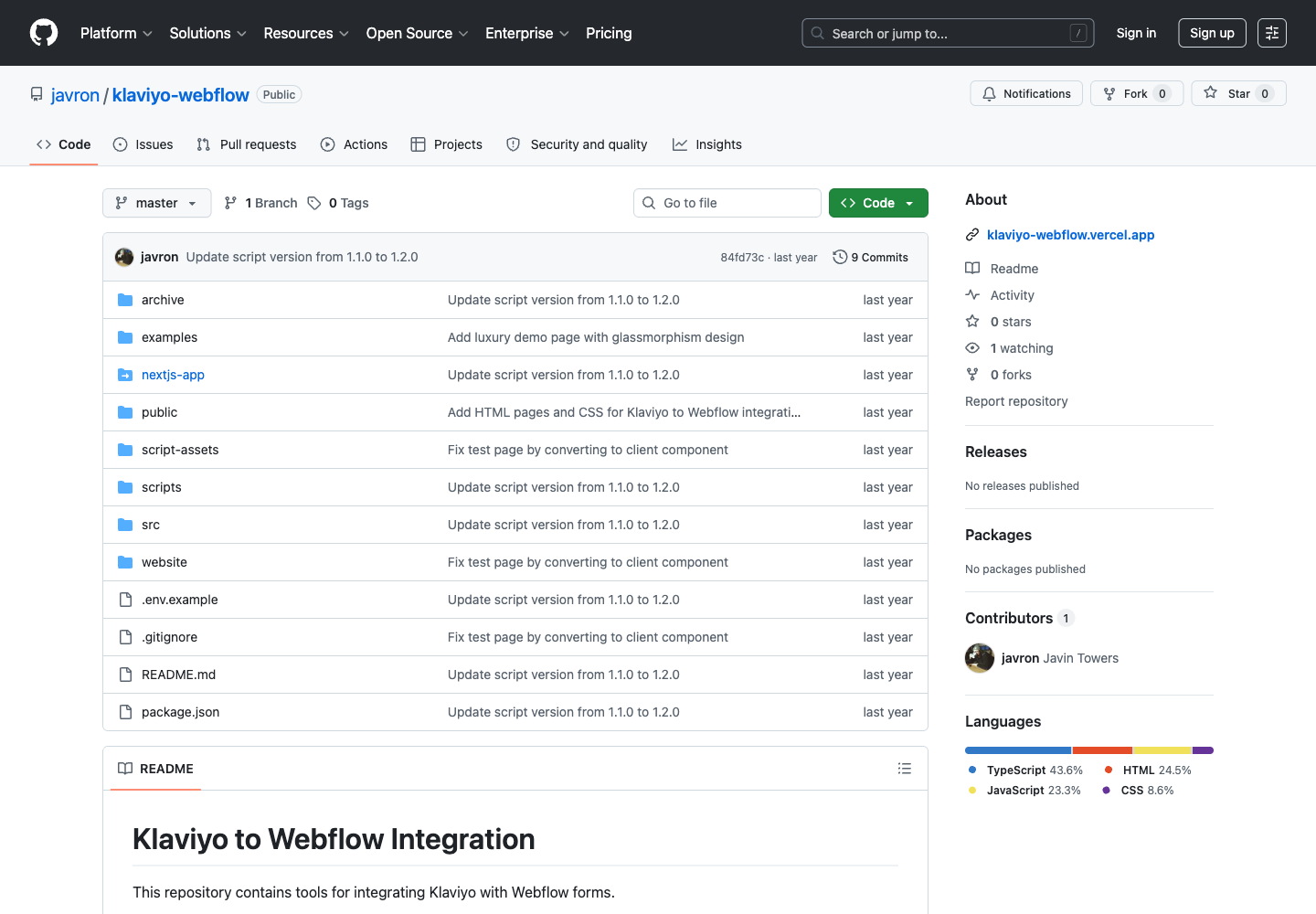
Klaviyo to Webflow started from a very practical annoyance. Webflow forms are easy to build, Klaviyo is where a lot of marketing teams actually want their subscribers, and the path between the two is weirdly more annoying than it should be. Most solutions either send people through Zapier, ask them to write custom code, or hide the hard part behind instructions that only make sense if you already know what you are doing.
I wanted the setup to feel closer to: add a script, add the right attributes, test it, and know whether it is working. That is the whole premise. A small integration should not require a huge implementation project.
What I Built
The core is a script-based integration that lets Webflow forms submit directly into Klaviyo. But the more interesting part is everything around the script. I built the setup docs, implementation guidance, hosted script/versioning approach, and testing path so someone can install it with a lot less uncertainty.
In my mind, a tool like this fails when it is technically correct but practically silent. If the script loads and nothing happens, the user needs to know why. Did the form initialize? Was the list ID wrong? Did Klaviyo reject the request? Did the domain load the wrong version? Without feedback, the person installing it is just guessing.
Tool Health and Analytics
So I treated the integration like a small product, not just a snippet. I added usage and tool-health tracking around the things that actually matter: script load success and failure, form initialization, submission attempts, Klaviyo success/error states, domain usage, site usage, install metadata, version metadata, and overall integration health.
That is the part I care about most. It is one thing to ship a script. It is another thing to know whether the script is being installed correctly, whether people are getting stuck, and where the integration is breaking in the real world. Even small products deserve that loop.
Why It Matters
This is a clean example of how I tend to build: the front-facing thing is simple, but the system underneath tries to make the user's path obvious. The audience is a mix of marketers, Webflow builders, and developers, so the product has to meet them in the middle. It cannot assume a full engineering team, but it also cannot be vague.
I like this project because it sits right between marketing operations, developer experience, and product analytics. It is not flashy, but it solves a real little problem. And honestly, those are often the tools people actually keep using.


